
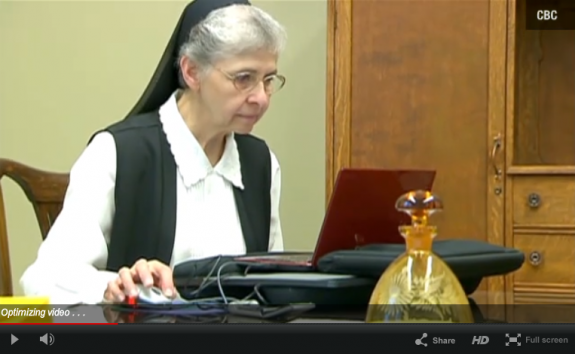
CNN has a nice feature video on the Good Shepherd Sisters in Quebec, highlighting their innovative methods to attract new vocations:
In The Church and New Media I noted a similar dynamic:
Fresh Wave of Religious Vocations
Today, when someone researches a particular company, the first place they usually turn is to the Internet. Likewise, when a Catholic is trying to find a local parish, many look online, gauging a parish simply by its website.
So it should come as no surprise that for many people discerning religious vocations, the Internet plays a big role in their discernment process. A recent survey revealed that 90 percent of those discerning a religious vocation said their inquiries were aided by the Internet.
That same survey showed that a religious community’s website was more essential than vocation directors, parish priests, parents, or friends when gathering vocational information. Simply put, the first place many people turn in their discernment process is not to a spiritual director but to Google.
Why is this? One reason is New Media’s anonymity, as mentioned before. It allows users to comfortably explore things they would normally be hesitant to approach. A young woman might be uneasy about visiting a convent or committing to a discernment retreat, but in the comfort of her home she feels free to explore the characteristics of different religious orders.
Vocation Match (www.VocationMatch.com) is one example of this in action. The site asks visitors a set of questions regarding personality type, living conditions, prayer styles, and hobbies, and then uses the answers to suggest compatible religious organizations. The site shows how technology can help discern God’s call. Other sites, like For Your Vocation (www.ForYourVocation.org), similarly use New Media to aid those discerning their vocation.
Dioceses wondering how to use New Media in this regard can imitate the successes of the Diocese of Bridgeport, Connecticut. Since the diocese began a vocational outreach page on Facebook, its number of seminarians has doubled.
Finally, religious orders that have embraced New Media can expect a rise in interest. For example, the Daughters of St. Paul, the Paulist Fathers, and the Society of the Holy Child Jesus are all examples of religious orders with a strong New Media presence.
Vocations won’t increase solely because a diocese or religious order has an attractive website or is active on Facebook. But just as New Media serves to pre-evangelize—a first step in the process of evangelization—so can New Media act as a vocational catalyst.