
Introducing StrangeNotions.com – Reason, Faith, and Dialogue

I have some extremely exciting news that I've been keeping under wraps for some time, and this morning it finally came out. At 9:00am ET, I launched StrangeNotions.com, a major evangelistic project which was two years in the making.
 
StrangeNotions
 
Strange Notions is designed to be the central place of dialogue between Catholics and atheists. One implicit goal is to bring non-Catholics to faith, especially followers of the so-called New Atheism. As a 'digital Areopagus', the site includes intelligent articles, compelling video, and rich discussion throughout its comment boxes.
 

(If you can't see the video above, click here.)
 
Strange Notions gets its name from St. Paul's speech at the Areopagus in Acts 17:16-34. There he proclaimed the Resurrection to the intellectual elite of the ancient world, who responded by saying, "you bring some strange notions to our ears; we should like to know what these things mean." StrangeNotions.com helps those asking the same thing today. Open-minded atheists will encounter reasonable arguments for God and his Church, maybe for the first time in their lives, and like St. Paul's listeners they’ll leave intrigued by these strange notions.

I've gathered several top Catholic minds to contribute to the site. Right now we have over 30 on board, including Dr. Peter Kreeft, Dr. Edward Feser, Fr. Robert Barron, Fr. Robert Spitzer, Dr. Benjamin Wiker, Dr. Christopher Kaczor, Dr. Kevin Vost, Christopher West, Jimmy Akin, Jennifer Fulwiler, Marc Barnes, Leah Libresco, Stacy Trascanos, Mark Shea, Carl Olson, and many more. The project has also received several great endorsements including these:
 

"Brandon Vogt is at the cutting edge of using the Internet and social media as a tool for evangelization...I believe that his latest endeavor, StrangeNotions.com, is an excellent example.”
— Bishop Christopher Coyne, Archdiocese of Indianapolis

"Brandon Vogt brings his energy, enthusiasm, and prodigious intellectual gifts to the Catholic conversation and demonstrates how social media can be used effectively to advance the mission of the Gospel."
— Fr. Robert Barron, founder of Word on Fire Catholic Ministries

 
This site is timely for several reasons:

  • On May 12 the Catholic Church around the world will celebrate World Communications Day. Pope Benedict XVI, shortly before he stepped down, composed this year's official message which he titled, "Social Networks: Portals of Truth and Faith: New Spaces for Evangelization." This project embodies that theme as it uses social networks as "new spaces" to evangelize.
  • Over the last ten years, the number of self-identified atheists in America has increased 500%. They're one of the country's fastest growing religious groups yet almost no Catholics engage them. Strange Notions is a frontier project in this needed effort.
  • In the midst of the Year of Faith and the New Evangelization, this is a creative example of using "new ardor, new methods, and new expressions" to evangelize.

Any way that you could cover the site, either with a blog post, an interview, or by sharing the video trailer would be a huge help.

If you have any questions, email me at contact@strangenotions.com. And please tell me what you think in the comment boxes!

Want to help your diocese master new media?

Digital Church Conference


Our world is swirling with new media. Facebook has over a billion users. Each minute YouTube adds 70 hours of video. And every day we send six billion text messages.

For most Catholics this is both exciting and terrifying. We know this technology is powerful. And we know that we should be using it. But much of the Church is simply afraid to dive in. They're wary of the dangers, they don't know where to start, and they're unsure how to move forward.

That's why Matt Warner, Josh Simmons, and I created the Digital Church Conference, a one-day guide to the digital continent. Through several talks, interactive demos, and panel discussions, we teach people everything they need to know, from perfecting their website, to building social networks, to evangelizing online.

On Wednesday, we're putting on our third Digital Church Conference, this time for the Archdiocese of Cincinnati (more details here). But we'd love to take it to every diocese in the country, including your own. The Church badly needs help in this area of extraordinary potential.

So can you please help spread the word? Pass this message on to your pastor, parish staff, diocese, communication director, or your bishop. Share the video on Facebook, Twitter, or your blog. We'd also love to do a guest post or interview on your website. We'd be grateful for any help you can give.

Website - DigitalChurchConference.com
Video Trailer - http://youtu.be/_9RoG0apajw

PS. If you ever need graphics, logos, websites, or video trailers for a project, I highly recommend Cory Heimann at Likable Art. Cory designed the video trailer above. As you can see, he's phenomenally talented. He's also strongly Catholic. Check out his past work and then reach him at coryheimann@gmail.com.

Pope Benedict’s Tips for Evangelizing Online

Pope iPad
 
Each year on the feast of St. Francis de Sales, patron saint of writers, the Pope releases his message for World Communications Day. Pope John Paul II devoted many of his messages to radio, telveision, and the mass media while Pope Benedict XVI has focused his messages primarily on the Internet.
 
My great passion is evangelizing through new media so I was thrilled to discover the title of this year's message: "Social Networks: Portals of Truth and Faith; New Spaces for Evangelization." Instead of generally focusing on the Internet this message centers specifically on social media.

The result is magnificent. The message just went live today and even a cursory reading reveals a Pope who fully grasps the power and potential of these tools. He approaches this topic carefully and with deep reflection and offers just the right balance of challenge and encouragement.
 
You can read the entire message online (its fairly short—less than 1,600 words). I read it this morning and here are some initial reflections:
 

"These spaces, when engaged in a wise and balanced way, help to foster forms of dialogue and debate which, if conducted respectfully and with concern for privacy, responsibility and truthfulness, can reinforce the bonds of unity between individuals and effectively promote the harmony of the human family."

 
From the get-go, the Pope recognizes what social media is all about: dialogue (hence, "social".) These tools are not like radio. They're not like television. They're not like print. They're not about transmitting information from one person to another. They're about connection and relationships. Like the journeyers to Emmaus, therefore, we shouldn't be afraid to find Truth through "conversing and debating" (cf. Luke 24:15.) It was while they were debating that "Jesus appeared among them."
 

"The development of social networks calls for commitment: people are engaged in building relationships and making friends, in looking for answers to their questions and being entertained, but also in finding intellectual stimulation and sharing knowledge and know-how."

 
Pope Benedict's first sentence is key. Nobody accidentally succeeds with social media. You won't find any successful online work from people who just said, "Hey, we'll just start a Facebook or Twitter account and maybe people will flock to us. Sounds easy!" Instead, the best websites, blogs, and social media accounts share one thing in common: commitment. They're intentional, they put in the work, they sacrifice the time, they create great content. In other words, they're committed. The online world is just like the offline world in this way. If you want to be successful, you must devote the necessary time, money, and thought.
 

"Often, as is also the case with other means of social communication, the significance and effectiveness of the various forms of expression appear to be determined more by their popularity than by their intrinsic importance and value."

 
Anyone who spends time on social media knows what the Pope means. It's a sad result of what he calls, "the dictatorship of relativism," the belief that there's no such thing as objective truth. It typically takes the form, "What's true for you is true for you, what's true for me is true for me."

As I mentioned in The Church and New Media, the Internet helps feed this attitude. Websites like Wikipedia suggest, "Truth is whatever the majority of people agree upon." Now in Wikipedia's case, thankfully, the information is mostly accurate. But the problem isn't the website; it's the philosophy that undergirds it. If truth is whatever the popular majority says it is, then objective morals and values fade into oblivion. When that happens, the dignity of each person, and the objective immorality of specific acts, are tossed aside. The twentieth century shows the final result: tyranny, persecution, and death.
 

"Popularity, for its part, is often linked to celebrity or to strategies of persuasion rather than to the logic of argumentation. At times the gentle voice of reason can be overwhelmed by the din of excessive information and it fails to attract attention which is given instead to those who express themselves in a more persuasive manner. The social media thus need the commitment of all who are conscious of the value of dialogue, reasoned debate and logical argumentation."

 
Socratic LogicFrom experience, I'd say about 75% of the comments I read online about religion include at least one logical fallacy. Fruitful online discussion demands we move past the inflated rhetoric, nasty name-calling, and unbridled tribalism which plagues social media in order to calmly and rationally discuss our most important issues.

But how do we get there? If you're like me, you didn't have any formal training in logic or argumentation. There was nothing in high school or college. So to brush up, you might consider a good overview like Dr. Peter Kreeft's excellent book, Socratic Logic. Taylor Marshall also has two great posts on the basics of logic and argumentation: How to Recognize Logical Problems in Theology and Philosophy and How to Recognize 7 Diversion Tactics in Philosophy and Theology.
 

"Believers are increasingly aware that, unless the Good News is made known also in the digital world, it may be absent in the experience of many people for whom this existential space is important."

 
I've been saying this for years. Chances are, the majority of your Facebook friends will never discuss Catholicism with anyone but you. If they don't hear about it from you, they never will.
 
Blogger Meredith Gould expressed this reality by paraphrasing St. Teresa of Avila:
 
"Christ has no online presence but yours,
No blog, no Facebook page but yours,
Yours are the tweets through which love touches this world,
Yours are the posts through which the Gospel is shared,
Yours are the updates through which hope is revealed.
Christ has no online presence but yours,
No blog, no Facebook page but yours."
 

"The digital environment is not a parallel or purely virtual world, but is part of the daily experience of many people, especially the young. Social networks are the result of human interaction, but for their part they also reshape the dynamics of communication which builds relationships: a considered understanding of this environment is therefore the prerequisite for a significant presence there."

 
Two things stand out here. First, the digital world may be somewhat virtual, but it's still real. It's still as significant as the offline world. Through social media, real people are having real discussions about real matters just like anywhere else. Thus it deserves our attention and evangelization.
 
Second, before we engage the online culture we have to know it. We have to study the language, the style, and the tools. Most social media users know that the Internet is full of irony, humor, pictures, videos, and snark, all of which are summed up in it's iconic form: the meme. As the great CatholicMemes.com shows, you're more likely to spread your message through memes than through 5,000 word manifestos.

Studying the online culture helps us better evangelize it. It reveals the best ways to reach people and today that includes videos and pictures and dialogue more than long blocks of text.
 

"In social networks, believers show their authenticity by sharing the profound source of their hope and joy: faith in the merciful and loving God revealed in Christ Jesus. This sharing consists not only in the explicit expression of their faith, but also in their witness, in the way in which they communicate “choices, preferences and judgments that are fully consistent with the Gospel, even when it is not spoken of specifically.""

 
FrancisPlease fight the urge to nod your head in agreement and mentally quote St. Francis of Assisi: "Preach the Gospel at all times; when necessary use words." He never said that.

But a relevant quote someone did say comes from Pope Paul VI: "Modern man listens more willingly to witnesses than to teachers, and if he does listen to teachers, it is because they are witnesses." (Evangelii Nuntiandi, 41.)

People remember how you act more than what you say. If you comment respectfully and joyfully, if your posts are surprisingly charitable, readers take note. If you're slow to condemn, quick to compliment, and respectful of even the most ludicrous comments, your witness will be compelling. I think of St. Thomas Aquinas' famous remark: "Rarely affirm, seldom deny, always distinguish." That's a good model to follow.
 
On other hand, if you're mean-spirited, if you're overly-sacrastic, if you're dismissive or arrogant, then people will reject your message even if the points you made were airtight. Maya Angelou nailed it when she wrote, "People will forget what you said. People will forget what you did. But people will never forget how you made them feel."
 
Also, the Pope's advice affirms people are more interested in you than your ideas. For most readers, sharing personal stories about how your Catholic faith has impacted your life in a positive, significant way is way more compelling than a sharp philosophical argument. Explaining how the Eucharist has transformed you, or how the Sacrament of Reconciliation has liberated you from sin, is much more effective than a detached defense of sacramental theology. People want the truth, yes, but they want to see lives changed by it. So don't just be a teacher; be a witness.
 
 
The Pope's words offer so much more to reflect and comment on. It's full of rich insights. Be sure to read the rest of the message and I'd love to hear what you think.
 

What stuck out to from the Pope's message?


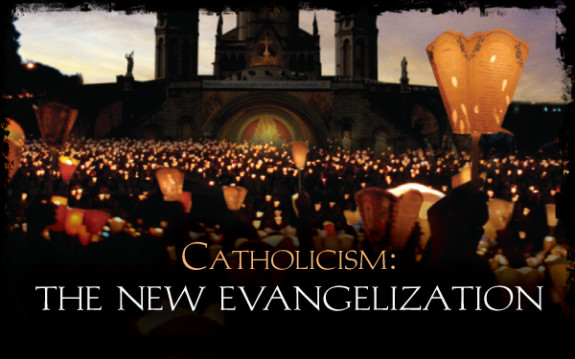
Video Trailer for “Catholicism: The New Evangelization”

Catholicism: The New Evangelization

Fr. Robert Barron and his Word on Fire ministry just released the official video trailer for their next film series, titled Catholicism: The New Evangelization. The documentary follows the success of Fr. Barron's ten-part Catholicism series. In this one he travels around the world, looking for examples of "new ardor, new expressions, and new methods" of spreading the Gospel. Watch below:


For more information and to sign up for free updates, visit the official website here. You can also catch an exclusive excerpt from the film at the Patheos Catholic homepage.
 
Patheos Catholic
 

Next Page »

  • "There is only one tragedy in the end, not to have been a saint." - Léon Bloy