
Through research for the upcoming Church and New Media book, I’ve been reading many books exploring the effects of electronic culture and the relationship between media and faith. Here are some short reviews of the latest books I’ve read:
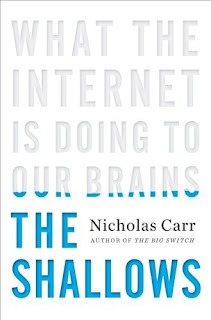
The Shallows: What the Internet Is Doing to Our Brains
Nicholas Carr
This book grew out of Nicholas Carr’s online essay, “Is Google Making Us Stupid?“. Carr hones in on “neuroplasticity“, which describes how our brain circuits re-wire and mutate based on the ways we use them (just as muscles strengthen or atrophy depending on their use). If you practice certain mental activities repetitively, the cell relationships within your brain actually conform in response, pulling ‘brainpower’ from mental activities not as heavily used.
Carr concludes that the shallow, non-linear, non-sustained way we engage online content has physically altered the way our brains work. This shift is has made critical thought, rational argument, and in-depth reading significantly more difficult for us moderns. We now approach books like we do blogs, movies like we do YouTube videos.
The book is kind of long-winded with scientific jargon and research summaries, but I think it’s the best resource describing how the Internet is changing the way we think.
(And of course, as I discuss in the upcoming book, these insights are extremely pertinent to Internet-addicted Christians trying to practice their faith.)

Is the Internet Changing the Way You Think?
Edited by John Brockman
What would happen if you gathered the 150 smartest people in the world and asked each of them to answer a single question? Every year Edge.com does just that. “Is the Internet changing the way you think?” was this year’s question, and the responses are very diverse. Some say “yes”, some say “no”; some say it has had positive effects, others say negative.
Most of the respondents are high-level scientists, mathematicians, or business figures–a disproportionate number considered how the Internet affects scientific research. There aren’t any religious leaders on the list, save for three of the “four horsemen” of New Atheism: Richard Dawkins, Daniel Dennett, and Sam Harris. Overall, the book is mainly a response from secular intellectuals. (How has the Internet changed how school teachers think? How about housewives? Farmers? Community college professors? Priests?)
In terms of content, Brockman’s book is way too long. Each respondent gets 2-3 pages, so the book is well above 400 total. After just a handful of responses, the contributions begin getting repetitive. Also, many of the contributions seem–at least to this non-scientist–to be little more than intellectual posturing, with respondents trying to prove genius by referencing dense scientific terms or theories.
I wouldn’t recommend buying this book. If you’re interested, borrow it or head to the store and browse the first couple of chapters. I think the best answer to the book’s question comes not from its own pages but from the Carr book mentioned above.

Amusing Ourselves to Death
Neil Postman
Postman’s classic media lament is over twenty years old, but is still relevant today. His premise is that modern media encourage us to approach every serious subject–religion, economics, political life, natural disasters, etc.–through the lens of entertainment.
The television, according to Postman, is this movement’s prime instigator. It has fashioned a “Now…this!” world where consumers are increasingly unable to gauge the importance or relevance of any piece of content. News from war is juxtaposed against celebrity baby news, stock reports are intermingled with sports scores, and it’s all packaged to be as appealing and entertaining as possible. Postman doesn’t have any issues with the lighter material on T.V.–sitcoms or cartoons, for example–because they don’t pretend to be serious subjects to begin with. The problem comes when serious subjects are cloaked in amusement.
This entertainment culture has particularly infected religion. Postman wrote the book at the peak of televangelism, so much of his ire is directed there. Televangelism was the natural result of the entertainment culture, a world where the most-beloved religious figures aren’t those who boldly speak the truth, but the ones who most amuse us.
To summarize, Postman compares the dystopias of George Orwell (1984) and Alduous Huxley (Brave New World). Most cynics worry that our world is heading toward Orwell’s “big-brother” governed society. But Postman thinks it was Huxley that had it right. Where Orwell had the government burning books, Huxley had it entertaining people to the point where they didn’t care to read books. Where Orwell governed people to death, Huxley entertained them to their demise.
The book’s concepts can be easily extrapolated to New Media, with the same cautions amplified.
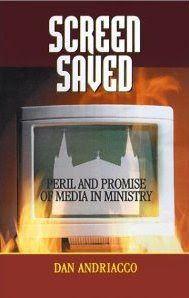
Screen Saved: Peril and Promise of Media in Ministry
Dan Andriacco
This is the best practical book I’ve come across on technology in ministry. It was written in 2001, so it doesn’t really deal with social media, but it does deal with the Internet and its effects on church life. How do we train people in the skills of media literacy? What type of technology is appropriate for the liturgy? How is the Internet affecting the mission of the Church? Part theological, part theoretical, and two parts practical, this book answers these questions from many angles.
The author, Dan Andriacco, is the Communications Director for the Archdiocese of Cincinatti making this one of the few books covering technology and religion written from a Catholic perspective.

The Gutenberg Elegies
Sven Birkerts
I’ve just started this one, but as a physical-book-lover in the Age of the Kindle, I’m fascinated. Amazon recently claimed that they now sell more e-books than hardcover books (though e-books still make up a small minority of all book sales). Online news sites have quickly demolished print news, with many major newspapers having already gone out of business. And more than three-quarters of Internet users regularly read blogs.
In light of these trends, how has all of this electronic literature changed the way we read? I believe the answer to this question will have profound ramifications for the ways that Christian study Scripture, for the discipline of spiritual reading, and even for how we think and process information. I’m really looking forward to the rest of this book.
(In case you missed it, I previously reviewed a couple of other New Media-oriented books written by Shane Hipps, an advertising-executive-turned-Protestant-pastor.)