
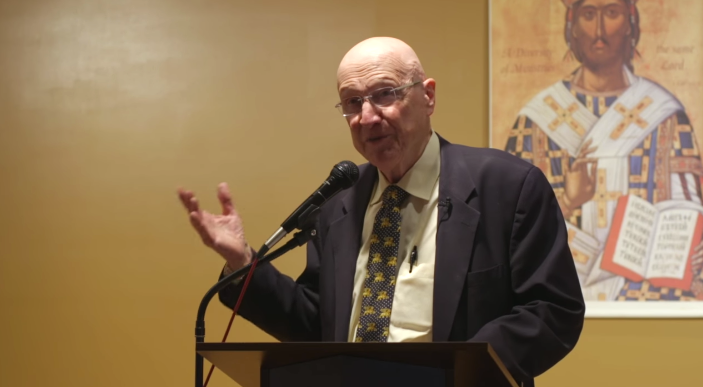
Peter Kreeft Book Giveaway (5/3)

"Find out how much God has given you and from it take what you need; the remainder is needed by others." - St. Augustine

Since I've built up a large collection of extra books and resources, each week I give away some absolutely free, no strings attached.

Each giveaway lasts seven days with a new one beginning every Friday. You can enter any time during the week. Check out my past giveaways here.


Jacobs Ladder

Thanks to the fine folks at Carmel Communications, today I'm giving away TWO copies of the newest book from America's brightest and wittiest Catholic philosopher, Dr. Peter Kreeft:
 

Jacob's Ladder: Ten Steps to Truth

by Peter Kreeft

Ignatius Press, 160 pages, paperback
Released on March 25, 2013

Jacob's LadderThere are ten important questions everyone should ask; and the answers to these questions, which lead to ultimate truth, are a matter of reason, not of faith.

Well-known Catholic philosopher and writer Peter Kreeft tackles each of these questions in a logical step-by-step way, like climbing the rungs of a ladder. Because questions are best answered by dialogue, Kreeft answers these fundamental questions in an imaginary conversation between two very different people who meet at the beach.

Kreeft's characters begin at the beginning, at the bottom of the ladder, which is the passion for truth. When it comes to the most important questions a person can ask, no mere interest in philosophical dabbling will do. The passion for truth does not stop there, however, but carries the reader from one page to the next in this thought-provoking adventure of the mind.

Among the topics, or "steps", that Kreeft's characters delve into include:

  • Do you have the passion to know?
  • Does truth exist?
  • What is the meaning of life?
  • What is love, and why is it so important for our lives?
  • If there is a God, what proof is there for his existence?
  • Has God revealed himself to us in a personal way?

And many other important questions and topics to help climb the ladder to the truth about life.


(If you don't see it above, click here to watch the video trailer.)
 
I'm using Rafflecopter to help with the giveaway, which is cool because it gives you multiple entries for commenting, posting on Facebook, sharing on Twitter, etc. Click below to enter:


(If you're reading this through email or RSS and don't see the giveaway widget, click here.)

Jacobs Ladder


The winner(s) will be randomly selected next Friday and the books will be sent out, free of charge, shortly thereafter.

In the future I'll be giving away more books and resources, sometimes multiple items per giveaway! So subscribe via feed reader or email to ensure you never miss your chance to win.

(Since I'm covering the shipping costs, only residents within the continental United States are eligible to win.)

My Favorite 15 Books of 2012 (#15-#11)

My Favorite Books of 2012

NOTE: Check out favorite books #10-#6 and #5-#1. You might also enjoy my favorite books from 2011 and 2010.
 

"The habit of reading is the only enjoyment in which there is no alloy; it lasts when all other pleasures fade." — Anthony Trollope

 
Compared to past years, 2012 was a relatively slow reading year for me. After knocking out 87 books last year and 108 two years ago, I only finished 54 titles this year. Granted, 2012 brought many wonderful diversions: our third child, Augustine, was born; I studied hundreds of hours for the Professional Engineering exam (which I passed!); I had several new writing and speaking commitments; I sent 12,000 CDs to Africa and promoted great Catholic speakers; and I worked on two large book projects. Considering all that activity I’m actually surprised I read as much as I did.
 
Yet 54 books still provide plenty of options for my annual favorites list. As with prior lists, these are my fifteen favorite books, not the most acclaimed, the most timeless, or the best-written. They're simply the ones I liked the most, the ones I kept thinking about well after finishing.
 
Only about half of these books were published in 2012. But as C.S. Lewis says, novelty isn't always good; newer books haven’t passed the test of time. Regardless, some of these older books may be unfamiliar to you and therefore “new” in the best sense of the word.
 
Also, this year I’m splitting the list into three parts. This year's list ended up being over 4,600 words which is way too long for a single post.
 
And with that, here are my favorite titles from 2012 (in descending order):
 

15. Confessions

St. Augustine of Hippo, translated by R.S. Pine Coffin
(Penguin Classics, 1961)

 
ConfessionsI had big hopes for St. Augustine’s classic, and it delivered in many ways. Augustine's probing journey from hedonism to Catholicism is one of the first biographies ever written and one of the most compelling.

Even translated, his writing is lyrical. Augustine expresses the primordial, haunting desire that eludes him. In his hunt for its source he samples many philosophies and religions before finally settling on Catholicism, and the book takes you on the entire journey. My wife and I read Confessions together and were so moved by Augustine’s account that we named our newborn son after him.

That said, many parts of the book underwhelmed me. Maybe it’s because I'm an amateur philosopher who is fairly new to Augustine, or maybe it's because this was my first read-through (I heard the book gets better on successive reads.) The fault is likely mine more than Augustine’s, but I found many sections dragging. For instance, Augustine’s philosophizing about time didn’t enchant me like the rest of his memoir.

This year’s film-adaptation of the book, Restless Heart, re-colored much of the book for me, especially figures like St. Monica, Augustine's mother, and St. Ambrose, his friend and mentor. I also picked up Ignatius’ new Critical Edition version of the book, which features the translation by Maria Boulding, O.S.B., widely hailed as the best, and annotations providing helpful commentary.

While not the best book I read all year, Confessions was certainly one of my favorites. And I’m sure it will appear higher in future lists as I return to it again and again.
 

14. The Seven Big Myths about the Catholic Church: Distinguishing Fact from Fiction about Catholicism

Christopher Kaczor
(Ignatius Press, 2012)

 
From my earlier review:

The Seven Big Myths about the Catholic ChurchOver the last few years, I've had many discussions with Protestants, Mormons, atheists, and agnostics. And if there's one thing they share in common, it's a profound confusion about what the Catholic Church actually teaches. Venerable Fulton Sheen was right: “There are not more than 100 people in the world who truly hate the Catholic Church, but there are millions who hate what they perceive to be the Catholic Church.”

Dr. Christopher Kaczor agrees and in his new book, The Seven Big Myths About the Catholic Church, he clears up seven of the biggest misunderstandings. The myths include:

  • The Church opposes science
  • The Church opposes freedom and happiness
  • The Church hates women
  • The Church is indifferent to love because she rejects contraception
  • The Church hates gays
  • The Church opposes same-sex marriage for irrational reasons
  • The Church’s abuse crisis was due to priestly celibacy

In a religiously-illiterate world, evangelization is about clarification as much as proclamation. That makes Kaczor's Seven Big Myths about the Catholic Church a real winner. It's a valuable tool for the New Evangelization which helps clear away the biggest roadblocks people have to the Catholic Church.


13. My Peace I Give You: Healing Sexual Wounds with the Help of the Saints

Dawn Eden
(Ave Maria Press, 2012)

 
My Peace I Give YouA couple years ago I devoured Dawn Eden's memoir, The Thrill of the Chaste: Finding Fulfillment While Keeping Your Clothes On (Thomas Nelson, 2006.) It was an edgy, beautiful work highlighting Dawn’s journey from promiscuous agnosticism into the purifying arms of the Church.

As good as that book was, however, I think her newest one is better. In My Peace I Give You, Dawn takes readers down a path of healing by weaving her experiences of childhood sexual abuse alongside saints who were also hurt, mistreated, and abandoned. In her search for solace, she returns to the Cross, hiding herself in the wounds of the One who suffers with us, the crowning example of compassion.

Along the way, Dawn features several probing reflections on the nature of evil and suffering. A significant turn in Dawn’s healing came when she discovered the Catechism’s teaching that God does not positively will evil, though he permits it to honor free will and to bring a greater good out of it. As Dawn said during our interview, “the greater good that I believe he's brought through the evil I've suffered is the good of being able to be more closely united, through my wounds, with the wounded and Resurrected Christ.”

Despite the book’s title, it doesn’t just focus on sexual abuse. It covers many other kinds of suffering including physical, emotional, and verbal. Whatever wounds you have, Dawn’s evocative writing and the saints’ own witness will help you toward spiritual healing.


12. In Defense of Sanity: The Best Essays of G.K. Chesterton

G.K. Chesterton, collected by Dale Ahlquist, Aidan Mackey, and Joseph Pearce
(Ignatius Press, 2011)

 
From my earlier review:

In Defense of SanityWhen you dip your toes into Chesterton’s massive corpus, one thing becomes immediately clear: his skill at connecting disparate ideas. Chesterton pulls equally from art, religion, beauty, politics, science, and philosophy. He was convinced that all these subjects are intertwined and that right-thinking about one led to right-thinking about the others. In one of his novels, for instance, he linked Darwinian evolution to political progressivism. In an essay, he tied the scientific theory of relativity to modernity’s favorite philosophy, relativism.

Chesterton was convinced that “thinking means connecting things” and in Dale Ahlquist's view, nobody did this better than him. Therefore studying Chesterton is a great way to become complete thinkers ourselves.

The Complete Thinker unveils Chesterton’s expansive genius which touched almost every topic under the sun. If you want to learn how to be a complete thinker, pick up this book and learn from the true master.


11. Theology for Beginners

Frank J. Sheed
(St. Anthony Messenger Press, 1982)

 
Theology for BeginnersFrank Sheed, one of the great Catholic apologists of the twentieth-century, was known for presenting lofty theological concepts in simple, down-to-earth language. He was incredibly smart but knew how to write for the common man. In that way, he was very much like C.S. Lewis.

Sheed wrote several notable books including To Know Christ Jesus, my favorite life of Christ, God and the Human Condition, which Ignatius Press just republished as Knowing God, and Theology and Sanity, which Peter Kreeft considers one of the top five must-read books today. Sheed was also successful street-preacher who founded the Catholic Evidence Guild.

Theology for Beginners is probably his best-known book, and I think the ideal introduction to his writing. The book covers many foundational doctrines like creation, the nature of man, original sin, the Church, and the sacraments. It's an introductory systematic theology that would especially help RCIA students or recent converts.

Sheed’s chapter on the Trinity is the best I’ve ever read. He handles the notoriously abstract doctrine wonderfully by proposing the now-classic threefold image of Thinker, self-generating Thought, and the Love shared between them. God’s three-in-oneness still confounds but Sheed makes it easier to grasp.

For a smart, accessible overview of Catholic theology you can hardly do better than Theology for Beginners.
 

Click here for favorite books #10-#6.


What were your favorite books of 2012?


Peter Kreeft Book Giveaway (12/28)

"Find out how much God has given you and from it take what you need; the remainder is needed by others." - St. Augustine

Since I've built up a large collection of extra books and resources, every week I give some away absolutely free, no strings attached.

Each giveaway lasts seven days with a new one beginning every Friday. You can enter any time during the week. Check out my past giveaways here.


Weekly Giveaway

This week I'm giving away two excellent books by Peter Kreeft, a favorite author whom I recently interviewed:

Catholic Christianity

by Peter Kreeft

Ignatius Press, 425 pages, paperback
 
Catholic ChristianityFor the first time in 400 years the Catholic Church has authorized an official universal catechism which instantly became an international best-seller, the Catechism of the Catholic Church. Using this official Catechism, the highly-regarded author and professor Peter Kreeft presents a complete compendium of all the major beliefs of Catholicism written in his readable and concise style.

Since the Catechism of the Catholic Church was written for the express purpose of grounding and fostering catechisms based on it for local needs and ordinary readers, Kreeft does just that, offering a thorough summary of Catholic doctrine, morality, and worship in a popular format with less technical language. He presents a systematic, organic synthesis of the essential and fundamental Catholic teachings in the light of the Second Vatican Council and the whole of the Church's Tradition.

This book is the most thorough, complete and popular catechetical summary of Catholic belief in print that is based on the universal Catechism.


Jesus Shock

by Peter Kreeft

St. Augustine's Press, 176 pages, hardcover
 
Jesus ShockJesus Shock is the second in a series of short works on seminal concerns of the impact that Jesus Christ made in the world. The first work, The Philosophy of Jesus, explored philosophy in light of Jesus, rather than the other way around. The present work investigates the reception Jesus received both in His lifetime and continuously to the present time, not only from His enemies, but from His friends, a reception of shock, astonishment, even disgust. Perhaps a few remarks from the book best explains it:

The point of the title: Imagine a storm has downed a telephone wire so that everyone who touches it is shocked in every cell of his body. Well, the storm of God’s crazy love has “downed” (incarnated) Jesus, and everyone who touches this “live wire” is shocked in every cell of his soul.

The question of the book: Why is “Jesus” the most non-neutral, the most controversial, the most embarrassing name in the world? Why is talking about Jesus like talking about sex?

This whole book is really about a single movie line, the greatest line in the greatest movie in history. Bet you know what it is....

What was the bitterest controversy of the Protestant Reformation, both between Protestants and Catholics and between different Protestant denominations, the one that had both sides calling the other not just heretics but devils?

Answer: It was not Justification by Faith, the hallmark of the Reformation, even though that question is about nothing less momentous than how to be saved, how to get to Heaven. It was not the relation between religion and politics, even though that was a matter of life or death (literally, on battlefields and at guillotines and hangings) and not just a matter of truth or falsity, or of good or evil. It was not about the sufficiency of the Bible, or the corruption in the Church, or the relation between the Bible and the Church. It was not about the Pope, and the governance of the Church. It was not about Mary or saints or angels or Purgatory. It was not about the Incarnation or the Trinity or the Atonement.

It was about the Real Presence of Christ in the Eucharist.

Jesus Shock, in addressing this controversy forcefully and faithfully, shows the reasons why to this day the name of “Jesus” stirs up controversy, even revulsion, in polite society. In the true spirit of ecumenism, it also points the way toward a true rapprochement among His modern-day disciples.

Here's Dr. Kreeft covering some of the ideas in Jesus Shock:

 
Weekly Giveaway

I'm using Rafflecopter to help with the giveaway, which is cool because it gives you multiple entries for commenting, posting on Facebook, sharing on Twitter, etc. Click below to enter:
 

(If you're reading this through email or RSS and don't see the giveaway widget, click here.)


UPDATE:

The drawing is now closed. Congratulations to Rondah S. for winning this week! Check your e-mail for instructions on receiving the items. If you don’t see an e-mail from me, check your spam box—apparently e-mails with “giveaway” in the title are prone to end up there.

In the future I'll be giving away more books and resources, sometimes multiple items per giveaway! So subscribe via feed reader or email to ensure you never miss your chance to win.

Weekly Giveaway (10/05)

"Find out how much God has given you and from it take what you need; the remainder is needed by others." - St. Augustine

Because I've built up a large collection of extra books and resources, every week I give away some absolutely free, no strings attached.

Each giveaway lasts seven days with a new one beginning each Friday, and you can enter any time during the week. Check out the past giveaways items here.


This week we talked a lot about the New Evangelization. There was Fr. Barron's YouTube video on the "7 Great Qualities of a New Evangelist," my own talk on "The New Evangelist," and an interview with Dr. Ralph Martin, expert on the New Evangelization. In addition to those events, this Sunday kicks off the long-awaited Synod on the New Evangelization in Rome.

So in line with that focus, this week's giveaway features two books to help you become a more effective evangelist.

The first is Mark Brumley's How Not to Share Your Faith: The Seven Deadly Sins of Apologetics and Evangelization (Catholic Answers, paperback, 124 pages.) Mark is the CEO of Ignatius Press and a well-respected apologist who is a regular guest on Catholic Answers Live. His book is an excellent field guide on avoiding the traps which threaten all people sharing their faith. Here's the summary from Amazon:

"Not long after converting to the Catholic faith, noted author and apologist Mark Brumley found himself in a discussion with a Protestant friend. Secure in his newfound faith—and feeling somewhat superior to his "less-enlightened" friend—Brumley smugly said, "Yes, I, too, used to think as you do." It was an outburst of pride that undermined Brumley's arguments for the faith and likely drove his friend further away from the truth. Brumley had just committed one of the seven "sins" he describes in his remarkable book, How Not to Share Your Faith: The Seven Deadly Sins of Catholic Apologetics and Evangelization.
 
In the book, Brumley describes seven of the most common and tragic mistakes he and other apologists have made over the years in their attempts to defend and explain the Catholic faith. More importantly, he reveals how you can avoid these mistakes and become far more effective at sharing your faith in a charitable way. Brumley's book isn't only about how to argue more effectively or how to make your points more clearly. It's about finding the most effective way to share your faith—even if that means losing an argument from time to time."

 
The second giveaway book is co-authored by Dr. Peter Kreeft and Fr. Ron Tacelli, two sharp philosophy professors at Boston College. The Pocket Handbook of Christian Apologetics (Intervarsity Press, paperback, 142 pages) is a slimmer, pocket-sized version of their must-read Handbook of Christian Apologetics. Here's the description from Amazon:

"'Be ready to give a reason for the hope that is in you,' wrote the apostle Peter. That is what apologetics is all about. Here is a concise, informative guide for anyone looking for answers to questions of faith and reason. Peter Kreeft and Ronald K. Tacelli have condensed their popular Handbook of Christian Apologetics, summarizing the foremost arguments for major Christian teachings and offering compelling responses to the most common arguments put forward against Christianity.

In this book you'll find answers to questions about:

  • faith and reason
  • the existence of God
  • creation and evolution
  • predestination and free will
  • miracles
  • the problem of evil
  • Christ and the resurrection
  • the reliability of the Bible
  • life after death
  • heaven and hell
  • salvation and other religions
  • objective truth

The Pocket Handbook of Christian Apologetics is the place to begin for people with questions about Christianity."


In order to win this week's giveaway, leave a comment below answering this question:

What do you find most difficult about sharing your faith?


The winner will be randomly selected next Friday and the giveaway item will be sent out, free-of-charge, shortly thereafter.

UPDATE:

The drawing is now closed. Congratulations to Heather T. for winning this week! Check your e-mail for instructions on receiving the book. If you don’t see an e-mail from me, check your spam box—apparently e-mails with “giveaway” in the title are prone to end up there.

In the future I'll be giving away more books and resources, sometimes multiple items per giveaway! So subscribe via feed reader or email to ensure you never miss your chance to win.

Next Page »

  • "There is only one tragedy in the end, not to have been a saint." - Léon Bloy