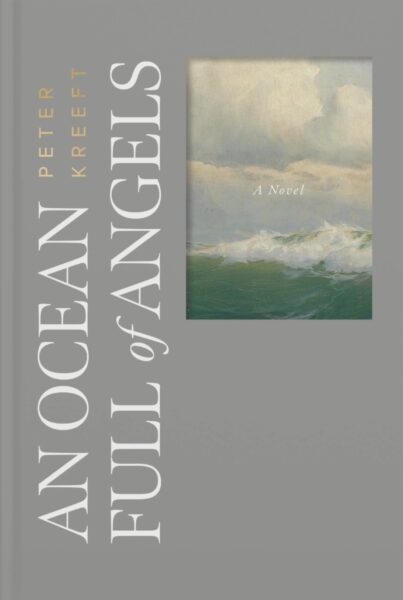
“An Ocean Full of Angels” – Review

 
Only two books have ever compelled me to pray immediately after finishing. One is Tolkien's masterwork, The Lord of the Rings, and the other is a new book by Dr. Peter Kreeft titled An Ocean Full of Angels (St. Augustine's Press, hardcover, 375 pages).

Why that effect? I think it's because both books are epic stories, and both authors are poet-scholars. First, stories are some of the best vehicles for truth. Lord of the Rings can tell us deeper things of good and evil than most textbooks on moral theology. An Ocean Full of Angels is in the same mold. And when you hear truth that pierces your soul, you can't help but pray.

Second, while Tolkien would deny being a philosopher, and Kreeft wouldn't call himself a poet, both are enormously gifted at each craft. Both writers blend truth with beauty and the result is soul-stirring prayer. Either one alone can be boring but both together cause "a surge of the heart, a simple look toward heaven."

Kreeft's book, in particular, is a whimsical memoir featuring a young Muslim philosopher who is searching for answers. But what makes An Ocean Full of Angels special is that it's a book full of wisdom. From the conversations to the plot to Kreeft's own interjections the whole thing is profound, cover to cover.

I don't know any other books like it. You could call the story Christian, but the main character is a devout Muslim. You could describe it as fiction, but the book is mostly autobiographical. It's not really a textbook, though it's packed with philosophy and theology. And while Kreeft's book reads like a novel--that's probably it's most appropriate genre--it doesn't follow the typical structure.

So how do you describe it? Well in the words of its publisher, An Ocean Full of Angels is "the damnedest novel you’ll ever read." How's that for a description? Even better, here's Kreeft's own sketch:
 

"An Ocean Full of Angels is an angel’s-eye view of the connections between Jesus Christ, Muhammad, dead Vikings, sassy Black feminists, Dutch Calvinist seminarians, very large Mother-substitutes, armless nature-mystics, Caribbean rubber dancers, the Wandering Jew, angels in disguise, three popes in one year, Cortez, Romeo and Juliet, the sea serpent, our Lady of Guadalupe, the demon Hurricano, islam in the art of body surfing, the universal fate wave theory, the Palestinian intifadah, the fatal beauty of the sea, dreams of Jungian archetypes, the dooms of the Boston Red Sox, the abortion wars, the Great Blizzard of ’78, the wisdom of the ‘handicapped,’ the ecumenical jihad, the psychology of suicide, and the end of the world.

But that’s an oversimplification."

 
On the one hand, An Ocean Full of Angels is unlike anything Kreeft has written. It's a far cry from his usual apologetics and philosophy.

But on the other hand, the content is vintage Kreeft. If you've read his other material you'll recognize many favorite themes--Socratic dialogue, C.S. Lewis, ecumenical jihad, pro-life philosophy, the strengths of Islam, the spirituality of the sea, and surfing on God among others. By connecting all of his past work together, the book stands as Kreeft's magnum opus, the pinnacle work of this modern sage.

His other books are beautifully written, but not like this one. Here Kreeft's storytelling skills are on full display. He sings melodiously about Nahant, a small island-town off the coast of Boston where the whole story takes place. His lyrical love for the Nahant sea makes you want to book a trip there immediately (it is a real place.) And when Kreeft writes lovingly about Mara, the book's beautiful heroine, his words stir like a modern day Song of Songs.

Despite its elegance, though, the book does have a few issues. For one, it's afflicted by typesetting problems which unfortunately snap you out of the book's trance at times. Also, the book's plain, unattractive cover doesn't do justice to the brilliance inside. I'm afraid many people will pass up the book after judging it merely by its cover.

When it comes to the content, I'm sure many readers will object to the book's main character, 'Isa Ben Adam, being a devout Muslim. Kreeft values Islam and its emphasis on spiritual "submission" and so he paints Islam in a pretty favorable light. Yet 'Isa is balanced by a Catholic counterpart, a large, African-American woman known affectionately as "Mother". She's equal parts Aunt Jemima and Socrates and is one of many eccentric characters.

Overall, if you like Kreeft, you'll like this book. But if you don't like Kreeft, you'll be confused, frustrated, and tempted to toss this book in the trash. Kreeft warns as much saying, "(this book) will probably "turn on" a very small audience, though I think it will "turn them on" deeply." In my case, at least, he couldn't be more right.

So if you enjoy Kreeft's other material, give this book a shot. Maybe you too will finish it in prayer.

(Next week's giveaway will feature a brand new copy of "An Ocean Full of Angels", so be sure to enter! Also, if you want more background, read Kreeft's article explaining the sources and motives for his book.)


  • JonMarc

    Awesome - Can't wait to get started!

  • http://www.facebook.com/dr.paologasparini Paolo Gasparini

    This is a post from Kreeft's dramatic masterpiece “An Ocean Full of Angel” wherein a young Islamic man, 'Isa Ben Adam, in America struggles to love his Mara and to unravel the mystery of the cosmic war that will last until the end of time. This scene is the turning point of the move, the breakthrough:
    "Not only did I betray Mara, not only did I betray our love, and not only did I betray my vow to Allah, I also betrayed my honor. She innocently trusted me to be her protecting knight, and the knight unleashed on her the dragon, whose fire consumed her innocence. Her innocence was suddenly an aborted baby lying dead at our feet."
    But the war was between him and his flesh, and between him and his mind, and between him and Mara, and between him and his religion, and between him and the Enemy.
    Now the conscience 'Isa's voice, Mother, point to an icon of Mary stomping on Satan and says: " All those pictures of her, or Michael the Archangel, or Jesus, overcoming Satan - did you think they were just about the past? The battle is still going on."
    A wall painting I saw years ago near Padua railway station, looking like Picasso’s “ Guernica”, had a similar caption: "It's not a movie, it's reality".
    More seriously, that was the horror of it: knowing who won the battle yesterday, or last century. The dragon speared Saint George instead of saint George spearing the dragon. So really happened in Rome, 1917, Fr. Kolbe, the Knight of the Immaculate, seeing a group of freemasons raising under the Vatican wall the standard of Lucifer spearing Michael the Archangel. From that move he conceived the idea of founding the Militia of Immaculata, the same year, raising also Russian Revolution, and legal abortion.
    Abortion is not merely a great evil, but a special kind of evil, something apocalyptic. Jesus quoted in His apocalyptic prophecies Daniel’s ‘abomination of desolation standing in the holy place’. He said that would be a sign of the end. It means abortion. The womb is, in fact, ‘the holy place’, where God creates new immortal souls, a greater deed than creating the whole universe 14 billion years ago, because souls never die but the universe does, and souls can know God but the universe can’t.
    Reading “holy place” my heart jumped for joy. I immediately remembered a quote from Professor Lejeune.
    Jérôme Lejeune (June 13, 1926 – April 3, 1994) discovered the existence of an additional chromosome on the 21st pair. With this remarkable and ground-breaking discovery, he renamed the condition Trisomy 21 to accurately describe the genetic abnormality. For the first time Dr. Lejeune had established a link between an intellectual disability and its genetic cause. As a well-known geneticist, he was called to the United States to testify in court in Davis v. Davis, the Tennessee Frozen Embryo Case, in Maryville, Tennessee in 1989.
    In 1962 he was honored in Washington, D.C. by President John F. Kennedy with the first Kennedy Prize for his research into genetic intellectual disability and for finding the genetic cause of Down syndrome. In 1969 he received the William Allen Memorial Award from the American Society of Human Genetics – the world’s highest honor in genetics. He remains the only Frenchman to have won it.
    Dr. Lejeune regularly traveled to Rome to meet with the Pope, to attend meetings of the Pontifical Academy of Sciences, and to participate in other events, such as the 1987 Synod of Bishops. In one of these events he attended a lecture at Padua’s University, and I also so the opportunity then to hear this exceptional man. Dr. Lejeune always viewed research as inseparable from treatment, and he was horrified as he gradually realized the consequences that misuse of his discovery would have for babies with. As the American tendency to eliminate sick unborn children became more prevalent throughout Europe, he wrote, “They brandish chromosomal racism like the flag of freedom…. That this rejection of medicine—of the whole biological brotherhood that binds the human family—should be the only practical application of our knowledge of Trisomy 21 is beyond heartbreaking….” It was this realization that drove Jérôme Lejeune to begin his fight for life. He died on the morning of Easter Sunday in 1994. The Pope was grieved: “Today we face the death of a great 20th-century Christian, a man for whom defending life had become an apostolate….” (From the Vatican, April 4, 1994).
    A few years later, during his visit to Paris for World Youth Day 1997, John Paul II visited Dr. Lejeune’s grave.
    He has been named "Servant of God".
    During a conference he said: “Je parlais à côté de Nagasaki à de charmantes petites sœurs qui sont d’origine française, qui sont maintenant presque toutes japonaises. Une sœur française était capable de traduire ce que je disais à cette petite communauté d’une vingtaine de sœurs qui m’avaient demandé : "parlez-nous des débuts de la vie, que nous connaissions un peu ces choses". J’avais donc employé l’expression "temple intérieur" qui m’était venue tout à fait spontanément sur les lèvres, et l’une des petites sœurs a interrompu ce que je disais pour dire quelque chose, très vite, en japonais, à la sœur qui traduisait. Bien entendu, cela m’a échappé. Et à la fin de l’exposé, la petite sœur qui faisait la traduction me dit : "Le mot utérus, en japonais s’écrit avec deux caractères différents, deux kunji : l’un des pictogrammes veut dire temple, et le second veut dire secret. Utérus s’écrit “temple secret”, cela prouve que les hommes de l’Orient Extrême, quand ils ont réfléchi, ont trouvé spontanément ce qui nous paraît une métaphore, et qui pour eux est une définition.”[Speaking near Nagasaki to a group of charming Japanese nuns of French extraction, one of them asked me to bring arguments for the beginning of life. I had just spontaneously mentioned the ‘holy place’, when another one, a native Japanese, suddenly interrupted me and whispered in her language something to the former. As a matter of fact, I missed that detail. At the end of the meeting the translator told me: “Japanese written word for uterus is expressed in two different figures, or kunji. A pictogram means ‘shrine’, the other one ‘secret’. Uterus, womb, is written “secret shrine.” The Orient gave a definition to what for us is merely a metaphor.]
    So the supreme blasphemy would be to worship the God of death in this secret shrine of the God of life.
    Now the least safe place of the world is not the battlefield but the womb. Pregnancy is now a disease to be cured. The most dreaded sexually transmitted disease is now a unborn child. Pagans in darkest Africa, e.g. in Karamoja, Uganda, where I had a missionary medical experience, when they hear it, literally can’t believe it. No sane primitive could believe it. How could we possibly be that ‘primitive’?
    A couple of years ago I scolded in my metropolitan ED a couple of guys, who were looking for emergency contraception. I told them that it was unjust to do that, when in my previous African medical service I had to safeguard threatening women’s life with ruptured uterus. The male abruptly answered: “ So, why don’t you go back, missionary?”. My answer was around this: “ You know, there I cared for thin bodies and smiling souls, here, in western countries, I daily deal with pierced, tattooed and gym-toned bodies but debased souls.
    This is insanity. Literally: moral insanity.”
    “That sounds terribly harsh.” (His mood, saying like that, was playing Devil’s advocate.)
    If I would have read the rest of the Kreeft’s drama, I would have said: “You fails, yes. So we all fail, and we lick our wounds and we go back into the battle against the dragon. But you are letting the dragon spearing her. You are supposed to be her protector from the dragon, like Joseph protecting Mary. But you are leaving her to the dragon, like Adam did to Eve. Where was Adam when Eve was being speared by the dragon? Where were we men, when Jesus was being speared by the dragon on the Cross? Only one stayed. The rest were women.”
    I will be immensely grateful for Kreeft’s unsparing honesty. His arrows shot straight into my heart with the truth, and there is no hope of any victory unless that arrow flies first.
    Thank you, Dr. Kreeft. Thank you very much for this inspired drama. Thank you for making me reflect back to the greatness of God’s and ours drama. Thank you indeed for forcing me to assess – for once soberly – my life’s real commitment, imitating St. Joseph – Posuerunt me custodem.

  • "There is only one tragedy in the end, not to have been a saint." - Léon Bloy